







Introduction
The success of any IoT ecosystem depends heavily on connectivity technologies. From short-range communication inside buildings to global industrial networks, choosing the right connectivity is critical for performance, cost, and scalability.
With over 31 billion IoT devices connected worldwide, technologies like BLE, LoRaWAN, and 5G are powering the backbone of Industry 4.0, smart factories, and intelligent systems.
Understanding IoT Connectivity Technologies
IoT connectivity can be broadly categorized into:
- Short-range communication (BLE, Wi-Fi)
- Long-range low-power networks (LoRaWAN, NB-IoT)
- Cellular networks (4G, 5G)
Each technology serves different use cases depending on range, power consumption, and data requirements.
1. Bluetooth Low Energy (BLE) – Short-Range Efficiency
BLE (Bluetooth Low Energy) is ideal for short-range communication with minimal power consumption.
🔹 Key Features:
- Low power consumption
- Short-range (up to ~100 meters)
- Cost-effective
🔹 Use Cases:
- Indoor asset tracking
- Wearable devices
- Smart home systems
BLE is widely used in smart factories for tracking tools, workers, and assets in real time.
2. LoRaWAN – Long-Range, Low Power Connectivity
LoRaWAN (Long Range Wide Area Network) is designed for low-power, long-distance communication.
🔹 Key Features:
- Range up to several kilometers
- Ultra-low power consumption
- Ideal for battery-operated devices
🔹 Use Cases:
- Smart agriculture
- Environmental monitoring
- Smart city infrastructure
LoRaWAN is perfect for IoT devices that need to transmit small amounts of data over long distances.
3. NB-IoT – Cellular IoT for Wide Coverage
NB-IoT (Narrowband IoT) operates on cellular networks and is optimized for low data rates.
🔹 Key Features:
- Wide coverage
- Low power consumption
- Secure and reliable
🔹 Use Cases:
- Smart meters
- Utility monitoring
- Industrial IoT applications
4. 4G & 5G – High-Speed Industrial Connectivity
Cellular technologies like 4G and 5G enable high-speed, reliable communication.
🔹 Key Features of 5G:
- Ultra-low latency
- High bandwidth
- Massive device connectivity
🔹 Use Cases:
- Autonomous robots
- Real-time industrial control
- Video surveillance systems
In Industry 4.0, 5G plays a critical role in enabling real-time automation and predictive maintenance systems.
How to Choose the Right IoT Connectivity
Choosing the right connectivity depends on several factors:
Factor
Best Option
Short-range, low power
BLE
Long-range, low data
LoRaWAN
Wide coverage, secure
NB-IoT
High speed, low latency
5G
Role of Connectivity in Industry 4.0
Connectivity technologies enable:
- Real-time machine communication
- Data-driven decision-making
- Predictive maintenance systems
- Smart factory automation
According to IBM, connected systems and analytics significantly improve operational efficiency and uptime in industrial environments.
Additionally, IoT For All highlights that combining connectivity with AI enables smarter, autonomous IoT ecosystems.
Future Trends in IoT Connectivity
🔹 6G and Beyond
Next-generation networks will offer:
- Even lower latency
- Higher speeds
- Enhanced AI integration
🔹 Multi-Radio Devices
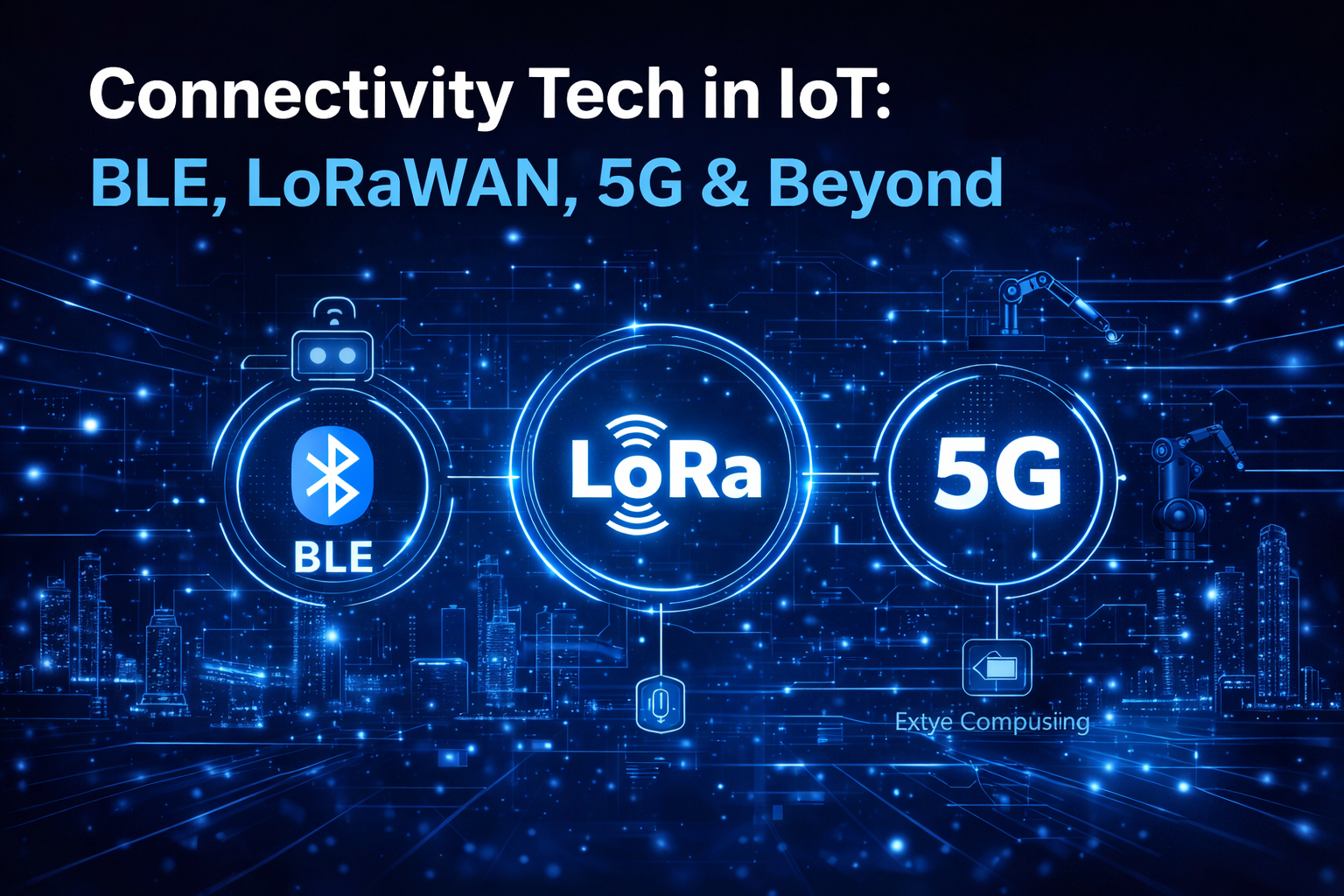
Future IoT devices will support multiple connectivity options (BLE + LoRa + 5G) for flexibility.
🔹 Edge Connectivity
Integration with edge computing will enable faster local decision-making.
Conclusion
IoT connectivity technologies like BLE, LoRaWAN, and 5G are the foundation of modern smart systems and Industry 4.0 solutions. Each technology serves a unique purpose, and choosing the right one ensures optimal performance, scalability, and efficiency.
As IoT continues to evolve, businesses must adopt the right connectivity strategies to stay competitive in an increasingly connected world.