








Introduction
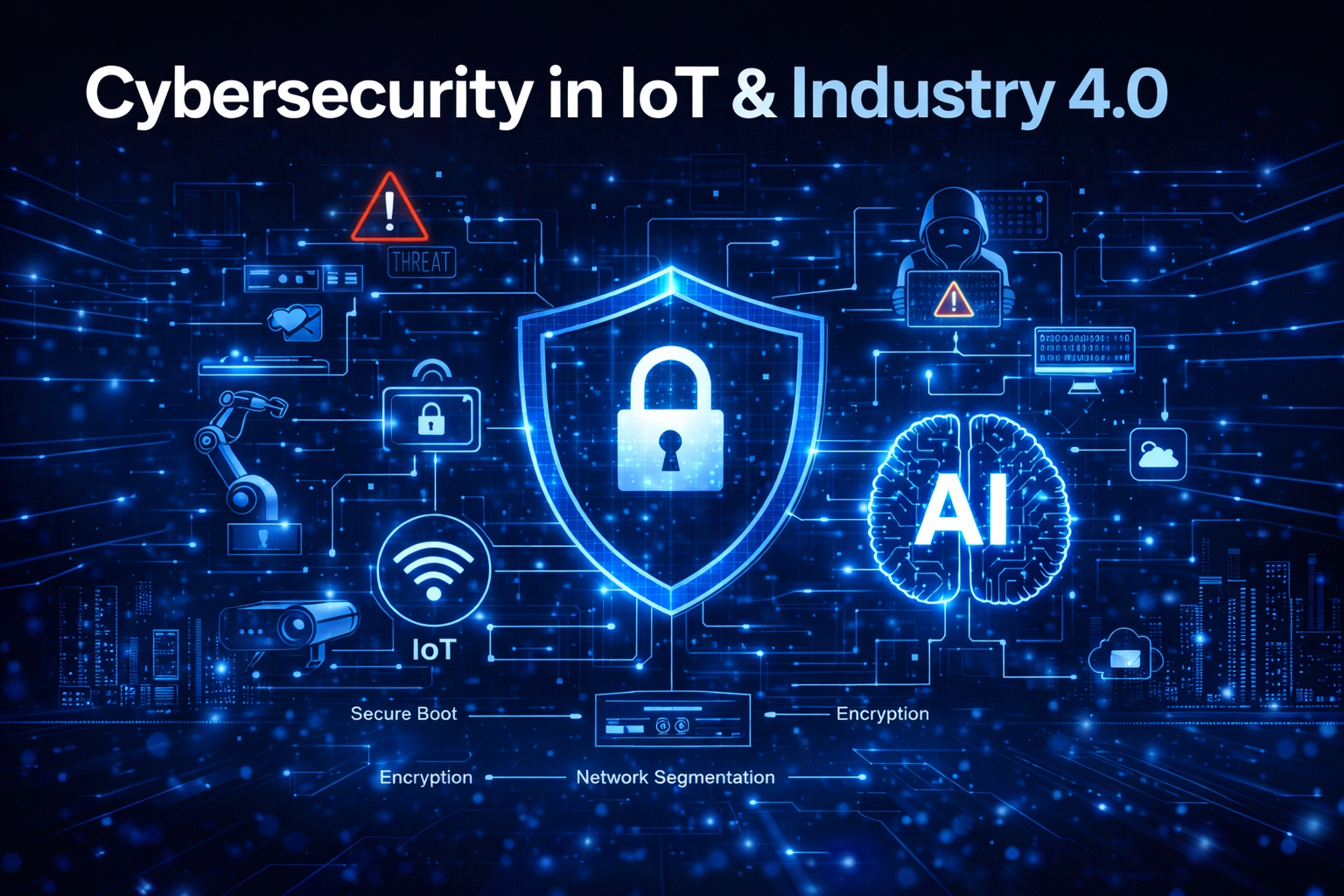
As industries embrace Industry 4.0, the rapid growth of IoT devices and connected systems has unlocked new levels of efficiency and automation. However, increased connectivity also introduces significant cybersecurity risks.
With over 31 billion connected IoT devices worldwide, securing digital infrastructure has become a top priority for businesses operating in smart factories and industrial environments.
Why Cybersecurity is Critical in IoT
IoT ecosystems involve multiple connected components:
- Sensors
- Devices
- Gateways
- Cloud platforms
Each connection point creates a potential entry for cyber threats.
In industrial environments, cyberattacks can lead to:
- Production downtime
- Data breaches
- Equipment damage
- Safety risks
Common Cybersecurity Threats in IoT
🔹 Wireless Interception
Hackers can intercept data transmitted between IoT devices.
🔹 Device Tampering
Unauthorized access to physical devices can compromise systems.
🔹 Malware & Ransomware
Industrial systems can be targeted to disrupt operations.
🔹 Weak Authentication
Poor password policies make devices easy targets.
🔹 Unsecured APIs
APIs connecting systems may expose vulnerabilities.
Cybersecurity Challenges in Industry 4.0
In smart factories, IT (Information Technology) and OT (Operational Technology) systems are interconnected.
According to IBM, integrating IT and OT systems increases complexity and requires robust cybersecurity strategies to prevent vulnerabilities across connected environments.
Best Practices for IoT Security
1. Secure Boot
Ensure devices only run trusted and verified software.
2. Data Encryption
Encrypt data:
- At rest
- In transit
This prevents unauthorized access during communication.
3. Network Segmentation
Divide networks into smaller segments to:
- Limit attack spread
- Improve control
4. Strong Authentication
Use:
- Multi-factor authentication (MFA)
- Secure credentials
5. Regular Updates & Patch Management
Keep firmware and software updated to fix vulnerabilities.
6. Device Monitoring
Continuously monitor IoT devices for suspicious activity.
Role of AI in IoT Cybersecurity
AI is transforming cybersecurity by enabling real-time threat detection.
🔹 AI-Powered Security Capabilities:
- Detect anomalies in network traffic
- Identify unusual device behavior
- Predict potential cyber threats
As highlighted by IoT For All, AIoT systems enhance security by making devices intelligent and self-monitoring.
Cybersecurity in Predictive Maintenance & Smart Factories
In predictive maintenance systems, IoT sensors continuously send data for analysis.
If compromised:
- False data may lead to wrong decisions
- Machine failures may go undetected
Secure systems ensure:
- Reliable data flow
- Accurate analytics
- Safe operations
Building a Secure IoT Architecture
A strong IoT security framework includes:
- Secure hardware design
- Encrypted communication protocols
- Edge and cloud security integration
- Continuous monitoring systems
- Incident response planning
Future Trends in IoT Security
🔹 Zero Trust Architecture
Every device and user must be verified continuously.
🔹 Edge Security
More security controls will be deployed at the edge.
🔹 AI-Driven Threat Detection
Automated systems will handle security in real time.
🔹 Blockchain for IoT
Decentralized security for device authentication.
Conclusion
Cybersecurity is no longer optional in the era of IoT and Industry 4.0. As connectivity increases, so do risks. Businesses must adopt secure-by-design approaches to protect their systems, data, and operations.
By combining best practices, advanced technologies, and AI-driven security, organizations can build resilient and future-ready smart factories.