








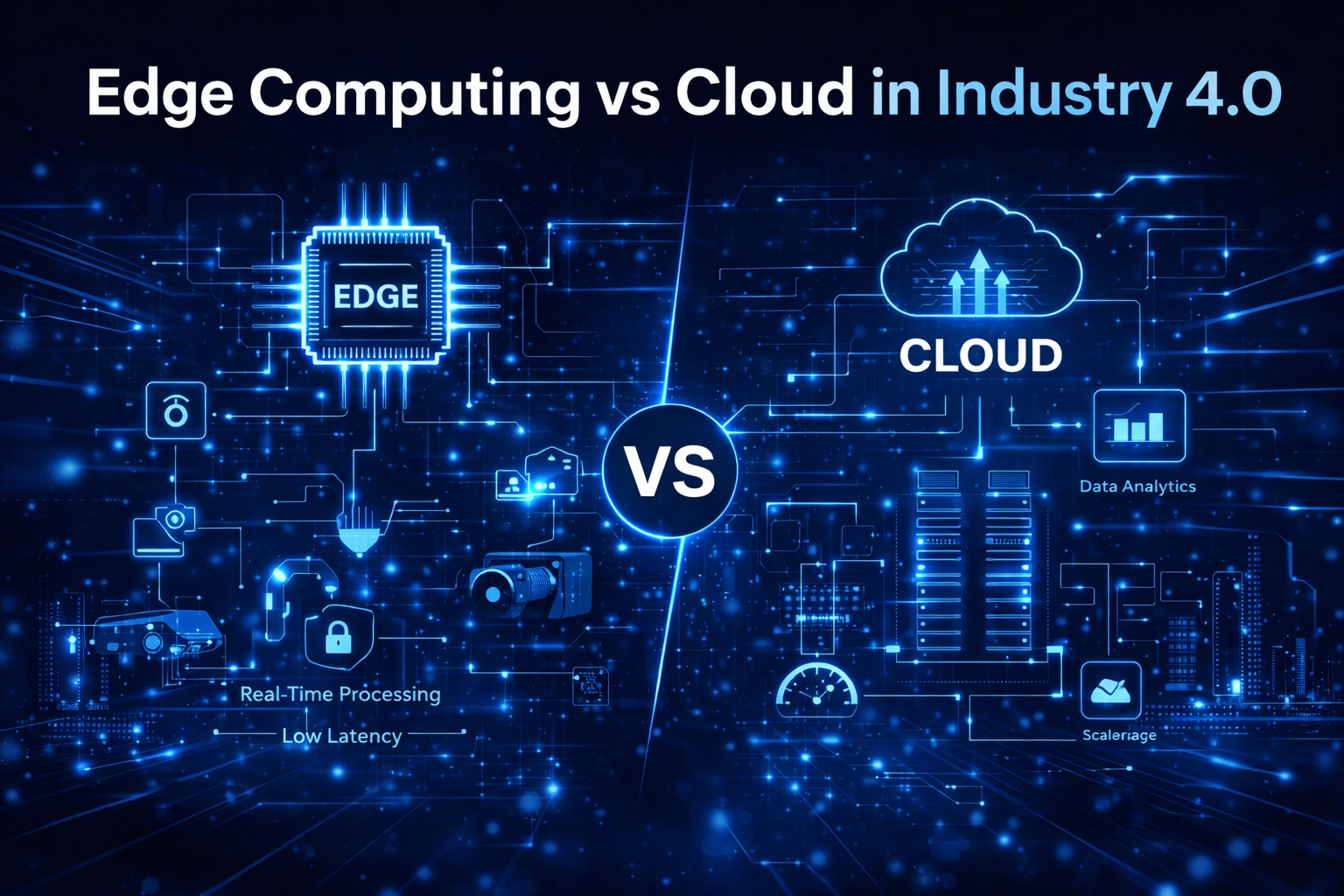
Introduction
As Industry 4.0 continues to evolve, businesses are increasingly relying on data from IoT devices to drive intelligent decision-making. However, one key question arises:
👉 Should data be processed in the cloud or at the edge?
The answer lies in understanding the strengths of both edge computing and cloud computing, and how they work together to power smart factories, predictive maintenance, and real-time automation.
What is Edge Computing?
Edge computing refers to processing data close to the source—near IoT devices, sensors, or machines—rather than sending all data to a centralized cloud.
🔹 Why Edge Computing Matters:
- Reduces latency
- Enables real-time decision-making
- Minimizes bandwidth usage
- Improves system reliability
In industrial environments, where milliseconds matter, edge computing becomes critical.
What is Cloud Computing?
Cloud computing involves processing and storing data in centralized data centers.
🔹 Key Benefits:
- Scalable storage and computing power
- Advanced analytics and AI processing
- Centralized data management
- Remote access and monitoring
Cloud platforms are ideal for big data analysis and long-term insights.
Edge Computing vs Cloud: Key Differences
- Real-time data processing and insights
- Reduced human intervention
- Improved operational efficiency
- Enhanced safety and reliability
- Scalable and adaptive systems
According to IBM, AI-powered analytics can significantly improve operational efficiency, particularly in industrial environments where downtime is costly.
Key Applications of AIoT in Industry
1. Predictive Maintenance
Predictive maintenance is one of the most impactful AIoT use cases. By analyzing sensor data from machines, AI can predict failures before they occur.
- Detect anomalies in equipment performance
- Reduce unexpected downtime
- Extend machine lifespan
- Optimize maintenance schedules
IBM highlights that predictive maintenance solutions can increase equipment uptime and reduce maintenance costs, making it a critical component of smart manufacturing.
2. Autonomous Quality Inspection
AIoT enables automated quality control using computer vision and machine learning.
- Real-time defect detection
- Improved product consistency
- Reduced manual inspection errors
- Faster production cycles
In a smart factory, AI-powered cameras and IoT sensors work together to ensure every product meets quality standards without slowing production.
3. Optimized Logistics and Supply Chain
AIoT transforms logistics by providing end-to-end visibility and predictive insights.
- Smart route optimization
- Inventory tracking using IoT devices
- Demand forecasting using AI
- Reduced transportation costs
This leads to faster deliveries, lower operational costs, and improved customer satisfaction.
Feature
Edge Computing
Cloud Computing
Data Processing
Near device
Centralized servers
Latency
Very low
Higher latency
Speed
Data-driven, condition-based
Optimized performance & cost
Connectivity
Works offline/limited
Requires internet
Use Case
Instant decisions
Data analytics
Why Edge Computing is Critical in Industry 4.0
In a smart factory, real-time operations such as:
- Machine safety systems
- Quality inspection
- Robotics control
cannot afford delays.
According to IBM, real-time industrial processes require low-latency processing, making edge computing essential for critical operations.
Real-World Use Cases
1. AI Vision Systems for Quality Inspection
Edge AI systems analyze images instantly to detect defects.
Result:
- Immediate rejection of faulty products
- Improved product quality
- Faster production cycles
2. Predictive Maintenance
Edge devices process sensor data locally to detect anomalies.
- Faster fault detection
- Reduced downtime
- Increased equipment lifespan
3. Remote Industrial Sites
Factories in remote areas use edge computing to:
- Operate without constant internet
- Ensure continuous production
- Reduce dependency on cloud connectivity
Advantages of Edge Computing
🔹 Ultra-Low Latency
Processes data instantly for time-critical applications.
🔹 Reduced Bandwidth Costs
Only important data is sent to the cloud.
🔹 Improved Security
Sensitive data stays closer to the source.
🔹 Reliability
Systems continue working even with network issues.
Advantages of Cloud Computing
🔹 Powerful Data Analytics
Cloud enables advanced AI and machine learning models.
🔹 Scalability
Easily handle massive amounts of IoT data.
🔹 Centralized Monitoring
Manage multiple factories from one platform.
🔹 Reliability
Systems continue working even with network issues.
Hybrid Approach: Best of Both Worlds
Most modern Industry 4.0 solutions use a hybrid architecture:
- Edge handles real-time processing
- Cloud manages analytics and storage
This combination ensures:
- Speed + intelligence
- Efficiency + scalability
As highlighted by IoT For All, combining edge and cloud enables smarter, more autonomous IoT ecosystems.
Role in Smart Factories
In a smart factory environment:
- IoT devices collect data
- Edge systems process critical information instantly
- Cloud platforms analyze large datasets
- AI models optimize production
This integration drives:
- Predictive maintenance
- Real-time monitoring
- Intelligent automation
Future Trends
🔹 Edge AI Growth
More AI models will run directly on edge devices.
🔹 5G + Edge Integration
Ultra-fast connectivity will enhance real-time processing.
🔹 Autonomous Systems
Factories will become self-optimizing and intelligent
Conclusion
Both edge computing and cloud computing play vital roles in Industry 4.0. While edge ensures real-time responsiveness, the cloud provides deep insights and scalability.
For businesses adopting IoT and AI, the key is not choosing one over the other—but combining both to build efficient, intelligent, and future-ready systems.