








Introduction
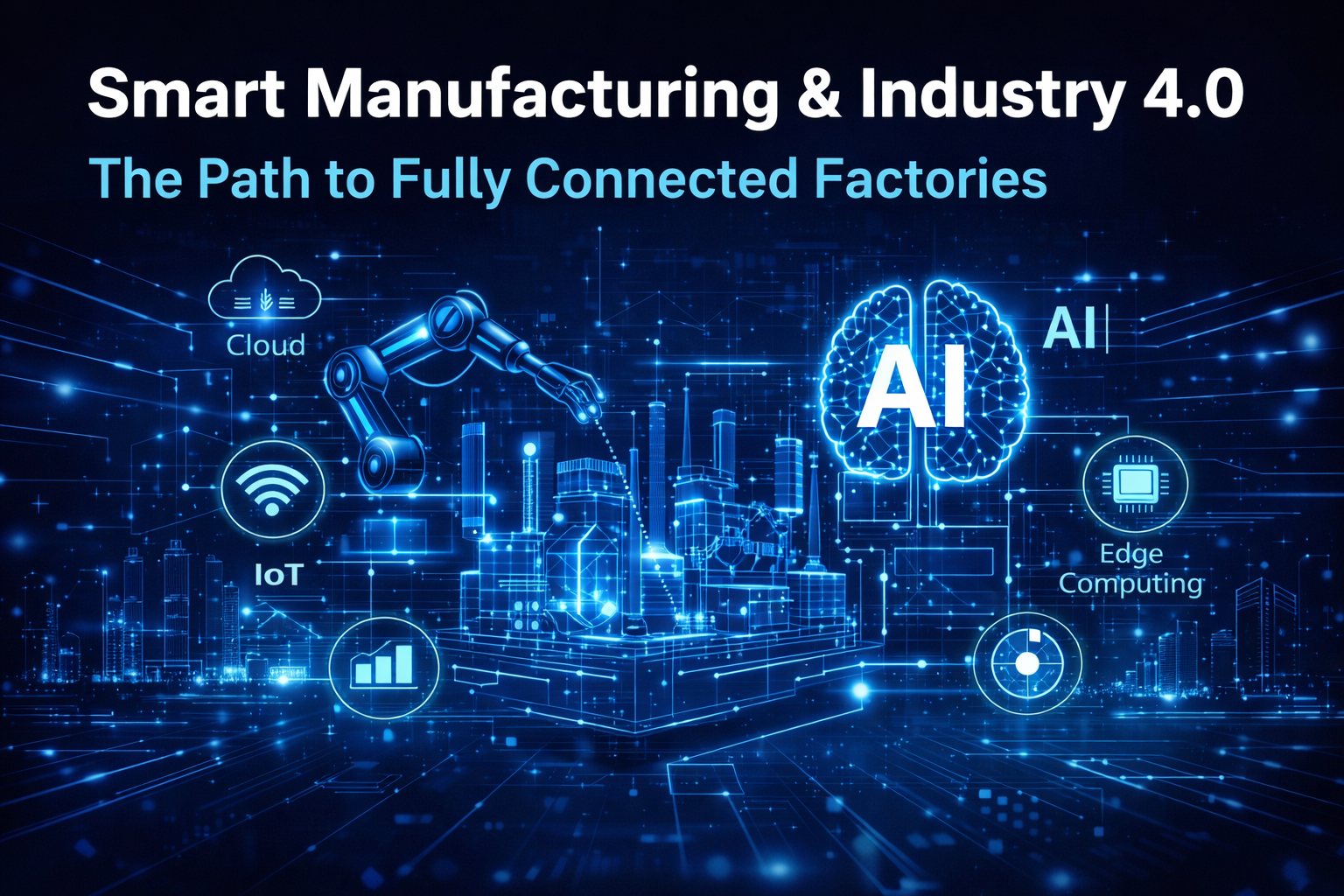
The manufacturing industry is undergoing a massive transformation with the rise of Industry 4.0. This new era focuses on smart factories, where machines, systems, and humans are interconnected through advanced technologies to create highly efficient and flexible production environments.
Smart manufacturing is no longer a future concept—it is a present-day necessity for businesses aiming to stay competitive.
What is Industry 4.0?
Industry 4.0 refers to the fourth industrial revolution, where digital technologies are integrated into manufacturing processes.
It enables:
- Real-time data monitoring
- Intelligent decision-making
- Automated and connected production systems
A smart factory leverages these capabilities to optimize operations, reduce waste, and improve productivity.
Key Technologies Powering Smart Manufacturing
1. Industrial IoT (IIoT) Sensors
IIoT sensors collect real-time data from machines, enabling:
- Equipment monitoring
- Predictive maintenance
- Performance optimization
2. Artificial Intelligence (AI)
AI analyzes large datasets to:
- Predict machine failures
- Optimize production processes
- Improve quality control
3. Cloud Computing
Cloud platforms allow:
- Centralized data storage
- Remote monitoring
- Scalable operations
4. Robotics & Automation
Advanced robotics enhance:
- Precision
- Speed
- Workplace safety
5. Digital Twin Technology
A digital twin is a virtual replica of a physical asset or system.
Benefits:
- Real-time simulation
- Performance optimization
- Risk reduction before implementation
Digital twins allow manufacturers to test and improve processes without disrupting actual operations
6. Edge Computing
Edge computing processes data closer to the source, reducing latency.
Advantages:
- Faster decision-making
- Reduced dependency on cloud
- Real-time analytics
How These Technologies Work Together
When combined, these technologies create a fully connected ecosystem:
- Sensors collect real-time production data
- Edge devices process critical data instantly
- Cloud systems store and manage large datasets
- AI analyzes and provides insights
- Digital twins simulate and optimize processes
This integration provides complete visibility and control over manufacturing operations.
Benefits of Smart Manufacturing
🔹 Real-Time Visibility
Manufacturers can monitor every stage of production instantly.
🔹 Increased Flexibility
Production systems can quickly adapt to changing demands.
🔹 Mass Customization
Products can be tailored to individual customer needs at scale.
🔹 Improved Efficiency
Automation reduces errors and increases output.
🔹 Enhanced Agility
Faster decision-making leads to quicker response to market changes.
Real-World Impact
In a smart factory:
- Machines communicate with each other
- Systems self-adjust based on real-time data
- Production becomes faster, safer, and more efficient
This results in:
- Reduced downtime
- Lower operational costs
- Higher product quality
Why Industry 4.0 Matters
Industry 4.0 is not just about technology—it’s about transforming the entire manufacturing ecosystem.
Businesses adopting smart manufacturing gain:
- Competitive advantage
- Better resource utilization
- Future-ready operations
Conclusion
Smart manufacturing powered by Industry 4.0 is revolutionizing how factories operate. By integrating IoT, AI, cloud, digital twins, and edge computing, businesses can create fully connected, intelligent production systems.
The future belongs to manufacturers who embrace this transformation today.